
Too often, environmental education remains theoretical. Students learn concepts about climate change, recycling or biodiversity, but rarely have the opportunity to connect them with their own communities, daily habits or capacity to act. This initiative aimed to change that.
Through the support of the Mediterranean Youth in Action (MYA) programme by the Anna Lindh Foundation, I had the opportunity to work with students, teachers and communities in a way that connected education with action.
The project brought together more than 200 students and over 20 educators through a combination of experiential workshops, teacher training, school-based implementation and community outreach.
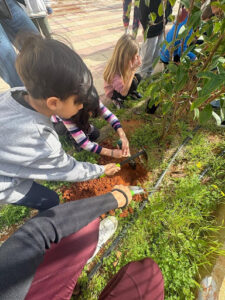
With students, we explored sustainability through hands-on activities: redesigning cities through sustainable mobility exercises, transforming old materials into useful objects through reuse workshops, learning about composting and ecosystems through experiments, and building stronger connections with nature through practical environmental learning.
One of my favourite moments was seeing how quickly children moved from curiosity to ownership. What started as guided activities soon became ideas, questions and actions led by the students themselves.
A particularly meaningful outcome was the community clean-up action in Chania, where approximately 150 students participated in cleaning coastal and public green spaces. What made this moment especially powerful was that the sixth-grade students took on coordination roles, demonstrating exactly the kind of active citizenship the project hoped to inspire.
But one of the strongest impacts came through the teachers. Rather than positioning educators as passive recipients of training, the project focused on equipping them with practical, adaptable methodologies they could integrate into their own classrooms. Seeing teachers take ownership of the tools and reinterpret them creatively was incredibly rewarding.
One teacher used reuse methodologies as part of mathematics teaching, transforming environmental learning into curriculum integration rather than an isolated activity. As one participating educator shared: “These activities gave us practical tools we can actually use with our students, not just ideas, but methods we could immediately apply.”
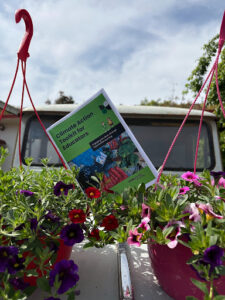
Another important outcome was the creation of the Environmental Education Toolkit, which consolidates the methodologies developed throughout the project into an open educational resource for wider use.
Of course, the journey was not without challenges.
Due to delays between the original project planning phase and actual implementation, some important decisions had to be made quickly and several aspects of the initiative had to be adapted in real time. While this required flexibility, it also became an important lesson in responsive project design.
I learned that meaningful community work is not about rigidly following a plan, but about staying faithful to the purpose while adapting to reality. Perhaps the most important lesson for me was this: environmental education becomes transformative when people feel ownership. When students lead, when teachers adapt, when communities participate, that is when education moves beyond awareness and becomes action.
Because real change often starts locally, collectively, and much more simply than we imagine.